Academic Act for the Memory of Blessed John Duns Scotus
Auditorium Antonianum, 11th November 2024
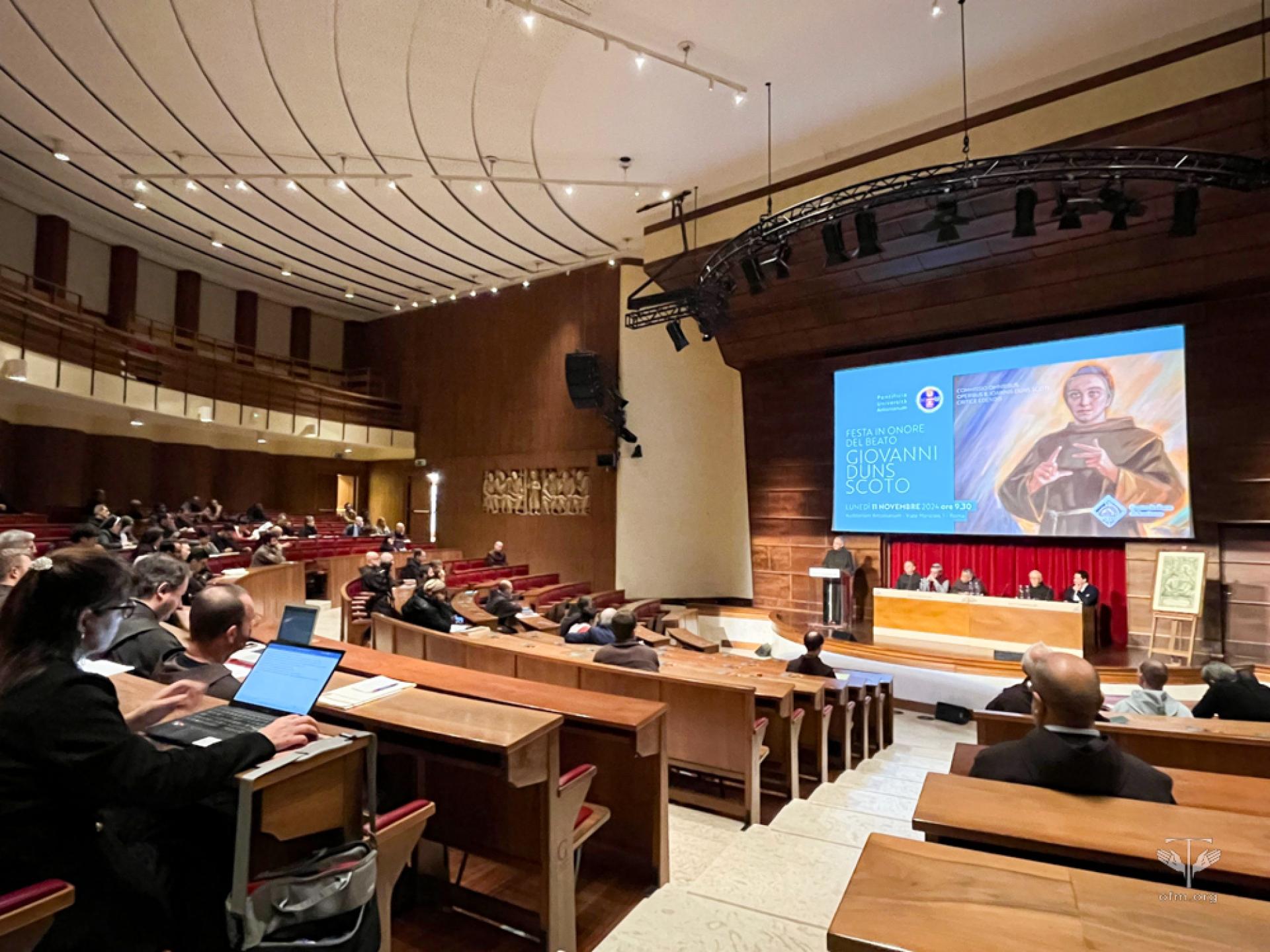
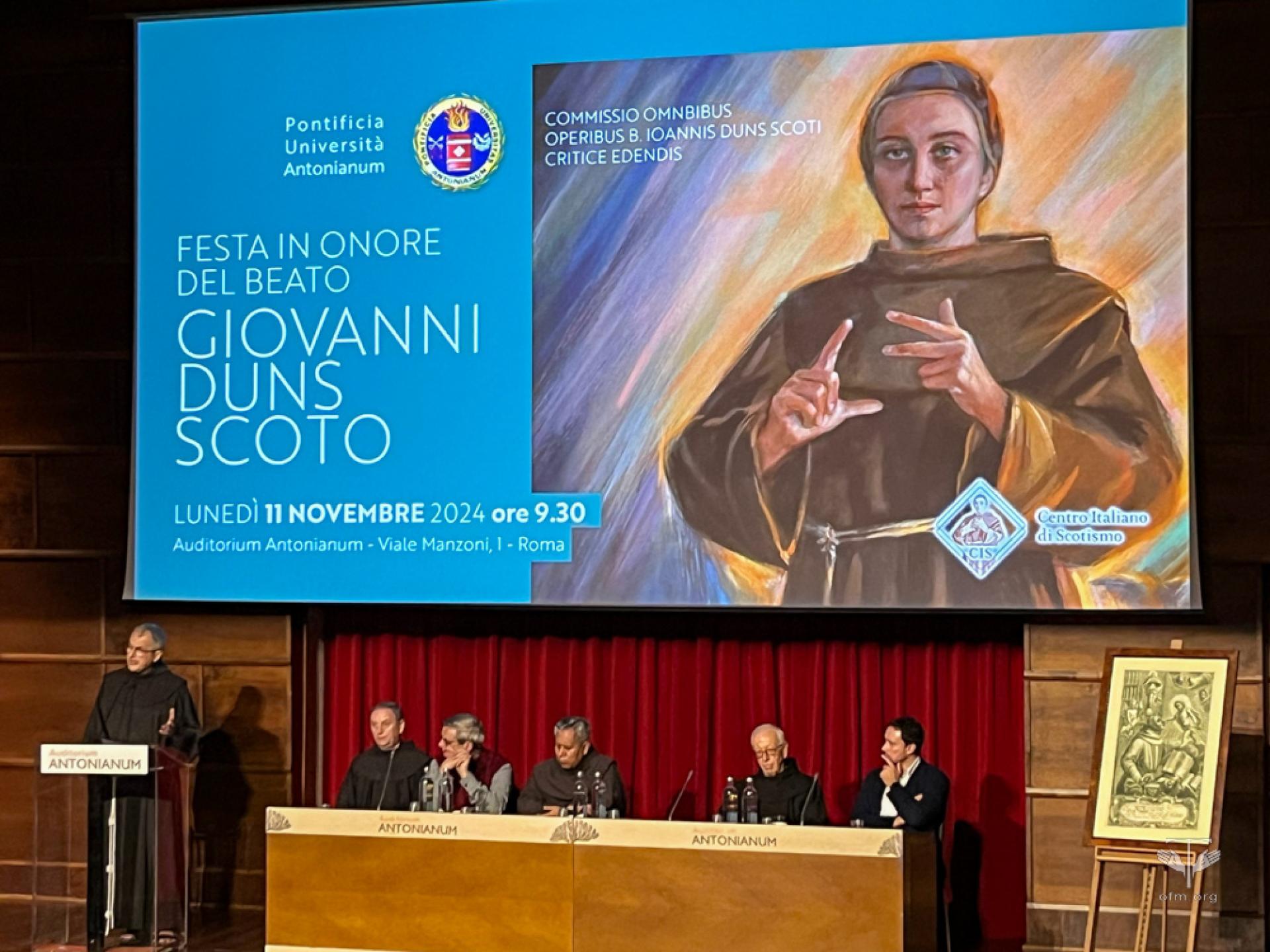
11 November 2024On Monday the 11th November 1, at the Antonianum Auditorium in Rome, the traditional Academic Act in honour of Blessed John Duns Scotus was held, organized by the Pontifical Antonianum University in collaboration with the Scotist Commission and the Italian Centre of Scotism (CIS).
The meeting was moderated by Br. Witold Salamon. After the words of greeting from the Rector Magnificus of the PUA, Br. Agustín Hernández Vidales, and the annual report of Br. Josip Percan, President of the Scotist Commission, Dr. Andrea Nannini of the Institute of the History of Theology spoke, with a report entitled "Freedom and contingency: metaphysical reflections starting from Lectura and Ordinatio, I, d. 39", in which the theme of freedom and contingency is mentioned. There are two different levels of contingency: diachrony and synchrony. The first is an Aristotelian concept according to which the will can be directed towards opposite objects in successive instants, in succession. Duns Scotus' synchronic contingency, on the other hand, derives from the freedom of the will and means that the will that wants "x" at the instant "t" may not want it "x" at the same time "t". According to Scotus, only the will is the principle of contingency in a synchronic sense, since only the will is potentia ad opposita simul. Duns Scotus' free will means a contingent action that comes from the unity of power and logical power.
Afterwards, Prof. Luca Parisoli, Scientific Director of the CIS, addressed the theme "Minimum considerations on Scotism".
The event was brought to its conclusion by Br. Massimo Fusarelli, Minister General of the OFM and Grand Chancellor of the PUA, who in his speech "Hope, an arduous virtue to cross a dramatic time", analyzed the importance of the theological virtue that is the object of the upcoming Jubilee, which in fact invites us to be pilgrims of hope. Br. Massimo recalled how Duns Scotus speaks of hope in his comments on the Sentences (Lectura and Ordinatio). “It is not only a theological virtue, but part of a spiritual dynamism that unites the human being to the love of God through desire, before on the cognitive level. It thus places him in a condition of trust and expectation in divine grace, oriented towards the goal of definitive beatitude", adding then “that hope seems to be, for Dr. Sottile, that virtue that "binds together the theological virtues, located in the powers of the soul of the believer. It is also thanks to it, in fact, that the Christian remains a pilgrim: always on the move and in search, even when he finds himself uncertain and precisely for this reason a beggar for hope".
But why call it an "arduous" virtue? Retracing the thought of Duns Scotus, the Minister General underlined how hope, for us Christians, refers to the love of God, to the expectation of the resurrection of the dead, to the ultimate goal that leads us to walk in life. So today, in a secularized world, it becomes truly difficult to take care of peace, justice and disarmament; of dialogue between people; of the common home; of democracy as participation and passion for relationships, respectful of differences and never exhausted from seeking what unites. "The urgency of these 'arduous' realities gives us the measure of the urgency of hope. This is not a passive consolation, but an active responsibility to make room for the power of the Gospel in the current conditions, in active expectation of the fulfillment of God's promises," said Br. Massimo.
In conclusion, the Grand Chancellor highlighted the importance of study and research in cultivating the reasons for hope, with the most solid roots, to consolidate paths and new practices of hope.
Read the full text of the Minister General's speech