In Thanksgiving for Br. Philippe Schillings OFM
For 22 years of service in Rome
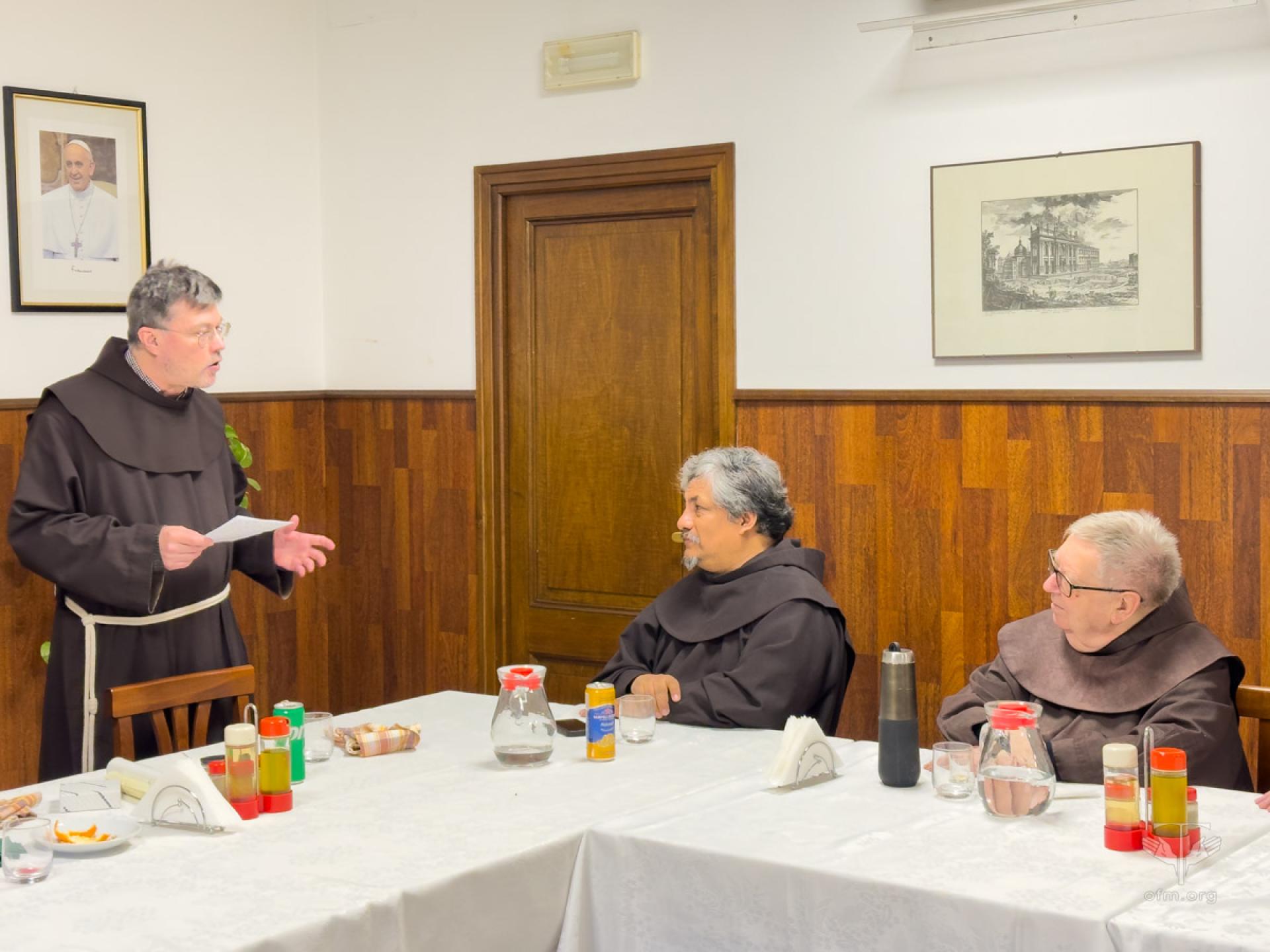
11 March 2025On the 1st March, at the Fraternity of Penitentiaries "St. John Lateran" a meeting was held between the friars of the local fraternity and some friars of the General Curia to thank Br. Philippe Schillings for his 22 years of service in Rome. John Lateran. The Vicar General, Br. Ignacio Ceja Jiménez, the General Definitors, Br. Albert Schmucki and Br. Jimmy Zammit, Br. Salvador Burgos León of the Translation Office, and Br. Byron A. Chamann Anlèu of the Communications Office participated in the General Curia.
Br. Albert thanked Br. Philippe for his 22 years of service in Rome, during which time he carried out various services: he served as an interpreter at five General Chapters of the Order and as a translator for the General Curia. He was also a confessor in several languages, first at St. Peter's as an extraordinary confessor and then at St. John Lateran as an ordinary confessor, where his service was greatly appreciated by the faithful. Br. Albert wished him a safe return to Brussels.
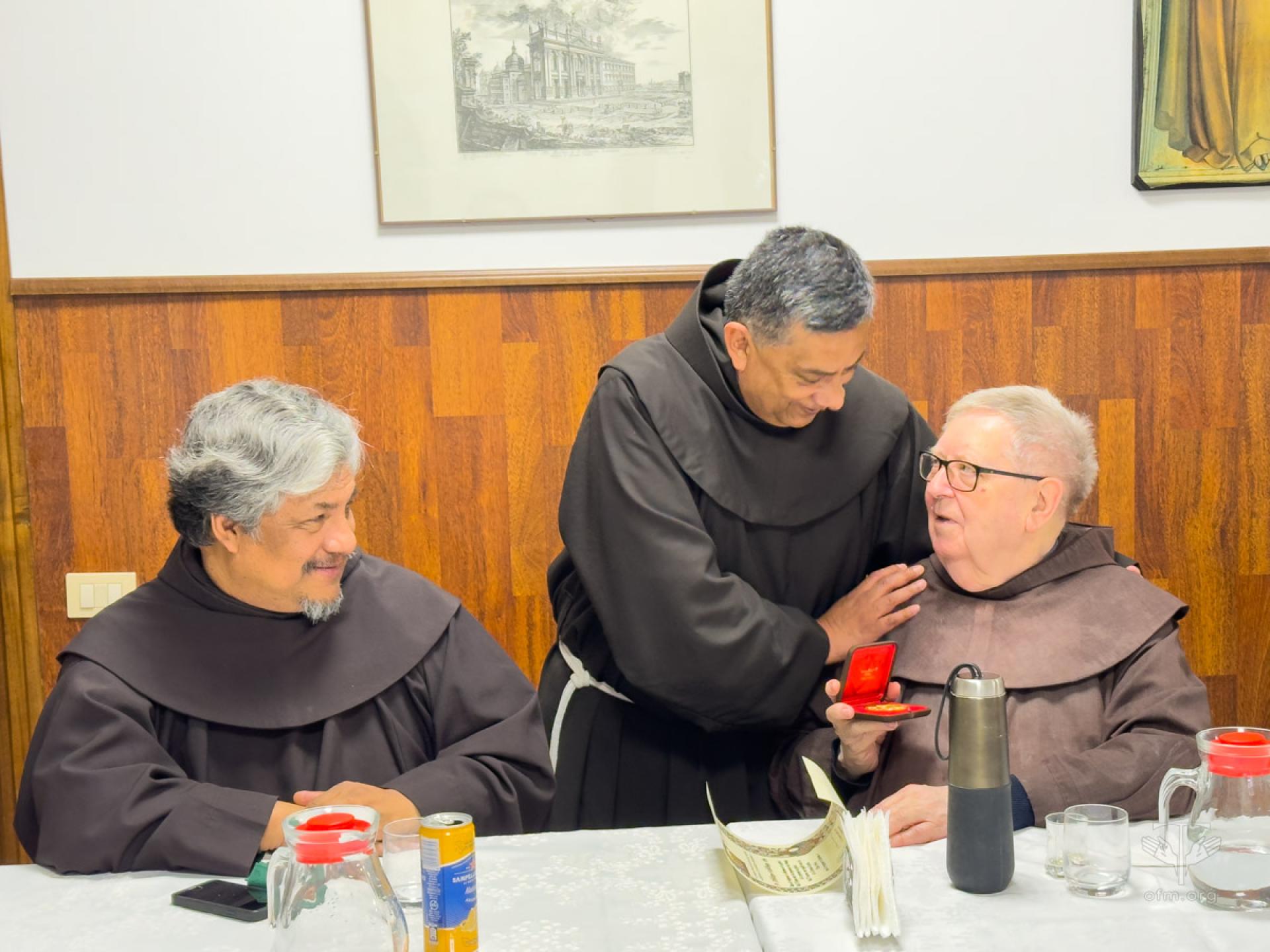
Subsequently, the Vicar General intervened and, recalling how Br. Philippe knows many languages, thanked him for his service as a translator. But he emphasized that the language he speaks best is that of service and on behalf of the Minister General he gave him the medal of the Order and a parchment with his blessing.
The Fraternity of the Lateran Penitentiary Friars: some historical information
In the course of the history of the Church, the Apostolic Penitentiaries were established to absolve in the name of the "Lord Pope" from various sins and censures those pilgrims who, especially in the Middle Ages, used to go to Rome to "do penance".
The first historical indication in this regard, however, appears only in 1215 in the documents of the Fourth Lateran Ecumenical Council. Even the sons of the Seraphic Father St. Francis, from the dawn of the Order, were co-opted amongst "these coadjutor penitentiaries" and therefore charged by the Apostolic See to attend to the ministry of confessions both in the Patriarchal (Papale) Basilicas and wherever the Papal Curia established its see. Not infrequently, indeed, we also meet them as family members and papal chaplains.
At the time, however, and until 1568, the practice in force at the Apostolic See was to choose the Apostolic Penitentiaries above all from among the religious of the various Mendicant Orders, such as, for example, the Dominicans, the Franciscans, the Servites, the Hermits of St. Augustine and the Carmelites.
However, in 1568-69 St. Pius V, in his vast liturgical reform, also reformed the Apostolic Penitentiary. And he did so by specifying the tasks of the Major Penitentiary and the Minor Penitentiaries, arranging the offices differently, establishing their powers and finally reducing the services of the Minor Penitentiaries to only three Basilicas in Rome (Rome). These are: St. Mary Major, which he entrusted to the Dominicans, St. Peter's in the Vatican, which he entrusted to the Jesuits, and St. John Lateran, which he entrusted to the Friars Minor.
From that date until today, the office of the Lateran Penitentiaries underwent several further changes and the Friars Minor continued to exercise, without any interruption, the noble Ministry of Minor Penitentiaries in the Archbasilica of St. John Lateran: "Omnium Urbis et Orbis ecclesiarum Caput et Mater".
The Franciscan Fraternity of the Lateran Penitentiary Friars, which officially calls itself the "Apostolic College of the Lateran Penitentiary Fathers", because of the specific mission it is called to carry out, namely that of dedicating itself totally to the ministry of Penance-Reconciliation in the Archbasilica of St. John Lateran, can be defined as an international Franciscan Fraternity "sui generis".
As a Fraternity of Friars Minor, in its constitution, organization and community life it depends directly on the Minister General. However, in everything that concerns the pastoral ministry to be carried out, it depends solely on His Emminence Cardinal Penitentiary Major, to whom he must always refer in every particular case.
Currently, the eight Lateran Penitentiaries, of various nationalities and different languages for the reception of penitents, are Ordinary Minor Penitentiaries and reside in a House assigned to them by the Holy See above the Cosmatesque cloister of the Basilica.