He was the only child of Giovanni Antonio de Signori and Maddalena Arrighi, both of whom were from the most illustrious families of Corsica (now part of France), originating from Liguria. Theophilus, born Biagio, was born on the 30th October, 1676, in the town of Corte. He spent his adolescence and early youth in his father's home, an ideal environment for his early human and religious development.
At the age of 17, already well-educated and drawn to the Franciscan ideal, he decided to leave his family to follow his religious vocation. After a brief stint among the Capuchins, on the 21st September, 1693, he entered the Order of Friars Minor at the nearby friary of St Francis, where he was given the name Theophilus. Two years after his religious profession, on the 22nd September, 1694, he was sent to the friary of Aracoeli in Rome to complete his philosophical studies and then to the friary of Santa Maria la Nova in Naples to further his theological studies. He was ordained a priest in this church on the 30th November, 1700.
He was appointed Lector in the first half of 1702; he chose to retreat to the solitary friary of St. Francis near Civitella (now Bellegra, in the Province of Rome) to prepare himself, including spiritually, for the teaching exam. There he met Tommaso da Cori: his example convinced him to choose a life of greater interior recollection, a life of penance and simple apostolate, carried out primarily by example. After a brief return to Rome, he finally decided to leave teaching and, with the permission of his superiors, settled in the retreat of Bellegra where, now a docile disciple and emulator of Br Thomas, he lived in heroic poverty and renunciation.
In 1709, Brother Teofilo was transferred to the nearby retreat of Palombara, where, also serving as Guardian, he remained from 1713 to 1715, before returning to Bellegra. He remained in this friary for another 12 years, living in the silence of the cloister, heroically practicing the virtues, and engaging in the most generous apostolate to the surrounding populations, serving as Guardian there several times as well. For thirty years, Teofilo alternated his presence between the two retreats: his fervent apostolic zeal also drove him tirelessly to travel the Aniene Valley, the Sabine Hills, and the Subiaco area, wherever he took up his ministry—the altar, the confessional, the bed of the dying, and the pulpit of the most disadvantaged villages.
In 1730, the superiors of the Order decided to establish a retreat in Corsica and entrusted its implementation to Br Teofilo, who returned to his homeland after a 34-year absence. Here, having overcome considerable hostility and difficulties, on the 30th December, 1732, he succeeded in establishing the new retreat of Zuani, which he himself governed as Guardian.
Recalled to Rome in the autumn of 1734, he was entrusted with founding a friary for retreats in Tuscany. Having overcome various difficulties here too, he managed to organise a retreat within the friary of Fucecchio, near Florence, which, under his expert guidance, soon became a centre of true spiritual attraction. In Fucecchio, Teofilo spent the last years of his laborious life, bearing witness to the Word with the eloquent language of his exemplary life, ardent with love for God and neighbour. Here, after a very brief illness, he concluded his earthly pilgrimage on the 19th May, 1740.
The fame of his sanctity and the numerous pilgrimages to his tomb led the ecclesiastical authorities to initiate the first canonical process for his beatification as early as 1750, which was subsequently decreed on the 19th January 1896 by Leo XIII. He was canonised by Pius XI on the 29th June 29, 1930.
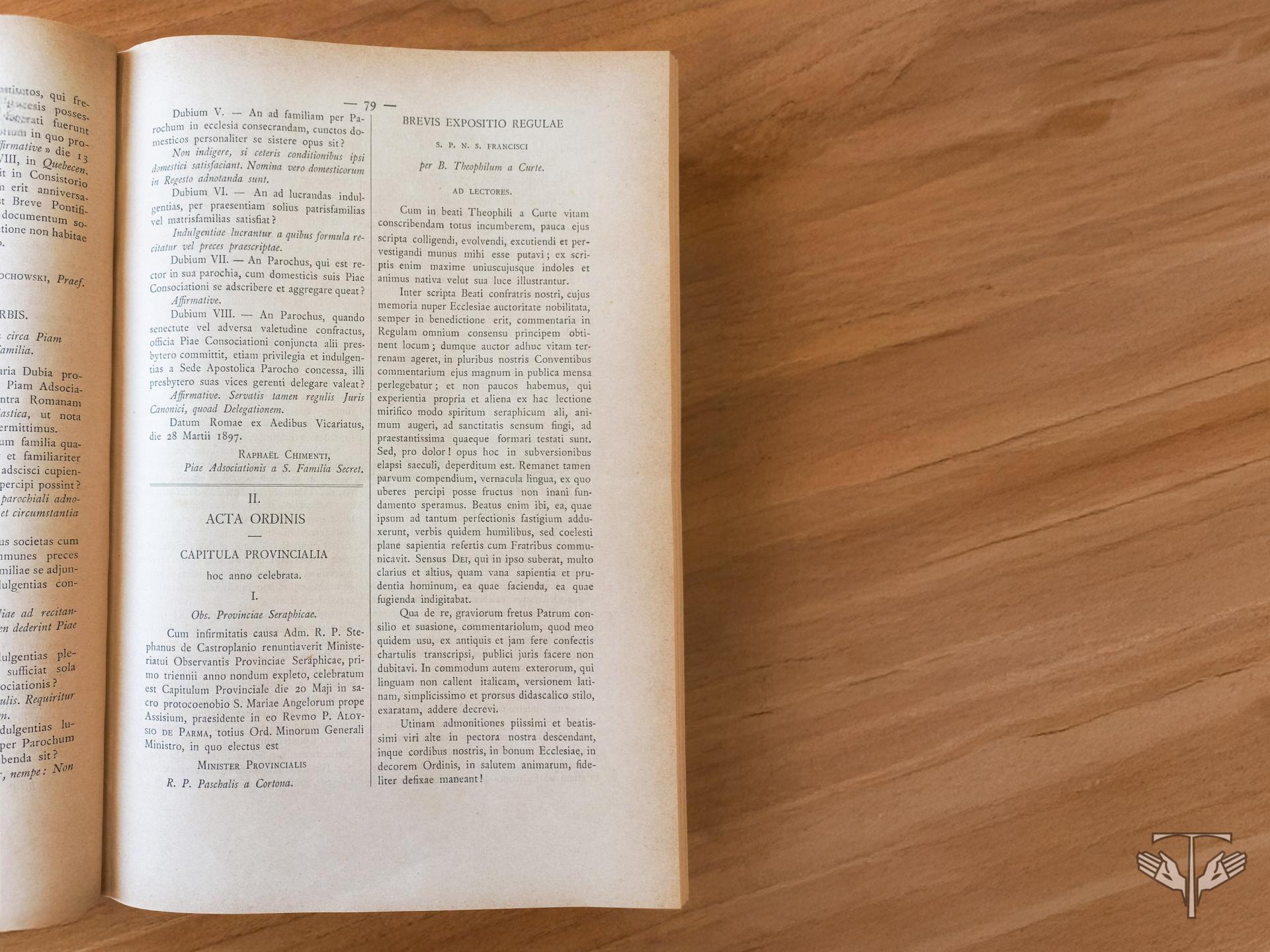
Several of his writings remain in Italian and Latin, such as the "Brief Exposition of the Holy Rule of Our Seraphic Father St Francis," published in Acta Ordinis in 1897-98 [the page where the publication begins is shown in the photo], and many letters, all addressed to Br Scalabrini, Provincial Minister of Tuscany, which recount the difficulties and events of the new friary in Fucecchio.
Other educational and spiritual writings, such as the "Ristretto della vita del Blessed Tommaso da Cori" and a "Miscellanea di vari cose spirituali e morali," have been lost.
See Frati Minori Santi e Beati, edited by Br. Silvano Bracci, OFM, and Sr. Antonietta Pozzebon, FMSC. Velar Publishing House, 2009, pp. 326-328.